Algorithms for the Earth: How AI Is Fighting the Climate Crisis
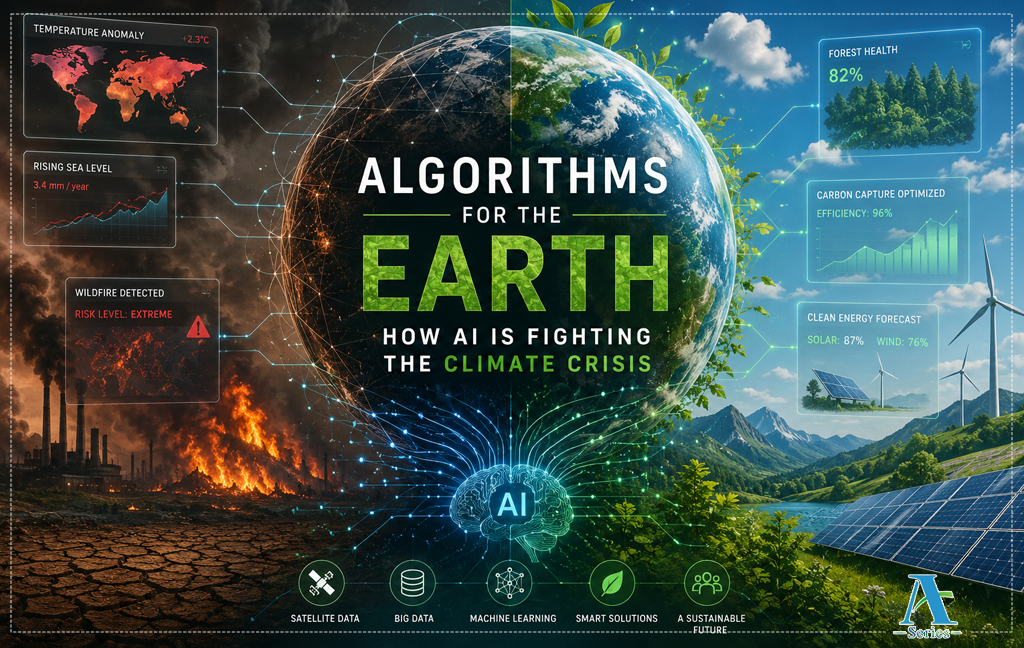
“With climate change accelerating at an unprecedented pace, scientists and policymakers are now betting on artificial intelligence to deliver the solutions the planet desperately needs.”
Climate change is no longer a distant threat. From record-breaking heatwaves to catastrophic floods, the consequences of decades of unchecked carbon emissions are being felt across every continent. Scientists agree that urgent, coordinated action is needed and quickly. In this race against time, artificial intelligence is emerging as a transformative force, helping governments, scientists, and businesses make smarter, faster, and more impactful decisions for the planet.
Smarter Energy for a Greener Grid
One of AI's most immediate contributions to climate action lies in the energy sector. Renewable energy sources like solar and wind are inherently variable the sun doesn't always shine, and the wind doesn't always blow. AI-powered forecasting systems can now predict energy output with remarkable accuracy, allowing grid operators to balance supply and demand in real time. Companies like DeepMind have demonstrated that AI can reduce the energy consumption of data centres by up to 40%, a breakthrough with massive implications for the tech industry's carbon footprint.
Smart grids powered by machine learning can also route electricity more efficiently, reduce waste, and integrate distributed energy sources from rooftop solar panels to electric vehicle batteries into a coherent, low-carbon system. This digital intelligence transforms our energy infrastructure from a rigid, fossil-fuel-dependent network into a flexible, responsive ecosystem.
- 40% Energy savings in data centres via AI
- 6–5.3GT CO2 reduction potential by 2030
- 70% Faster climate modelling with AI
Accelerating Climate Science
Understanding the climate system is extraordinarily complex. AI is giving scientists unprecedented power to process vast datasets satellite imagery, ocean temperatures, atmospheric readings and identify patterns that would take human researchers years to uncover. Machine learning models are now predicting extreme weather events days in advance, helping communities prepare and respond more effectively.
AI is also accelerating the discovery of new materials for clean energy from more efficient solar cells to better battery storage technologies. What once took a decade in the laboratory can now be simulated and screened in a matter of months, dramatically compressing the timeline from scientific insight to real-world deployment.
“AI will not save the planet on its own but may give us the speed, scale, and precision we desperately need to do so ourselves.”
Protecting Forests and Biodiversity
Forests are the lungs of our planet, absorbing roughly 2.6 billion tonnes of CO2 every year. Yet deforestation continues at an alarming rate. AI-powered satellite monitoring systems, such as Global Forest Watch, can now detect illegal logging in near real time, enabling faster enforcement responses. In the ocean, AI helps track illegal fishing and monitor coral reef health, protecting the marine ecosystems that regulate our climate.
Precision agriculture, guided by AI, is also reducing the environmental footprint of food production optimising irrigation, minimising fertiliser use, and cutting methane emissions from livestock all while maintaining or improving crop yields.
The Challenges We Cannot Ignore
AI is not without its own environmental costs. Training large AI models consumes significant amounts of energy and water. The hardware that powers AI systems relies on rare earth minerals, the extraction of which carries its own ecological toll. For AI to be a genuine ally in the climate fight, the tech industry must commit to running AI infrastructure on renewable energy and designing more efficient models.
There is also the risk of AI enabling greater consumption optimising logistics for faster delivery, for instance, while accelerating the volume of goods shipped. The benefits of AI must be consciously directed toward sustainability goals, not just efficiency and profit.
A Tool in Humanity's Hands
Ultimately, AI is a tool extraordinarily powerful, but shaped entirely by the intentions of those who build and deploy it. When governments, scientists, businesses, and communities align around climate goals, AI becomes a force multiplier for good. It can compress decades of research into years, turn mountains of data into actionable insight, and help us coordinate the most complex global challenge our species has ever faced.
The climate crisis demands the best of human ingenuity. AI, at its best, is an amplifier of that ingenuity helping us move further, faster, and with far greater precision than we ever could alone. The window to act is narrow. With AI as a partner, that window remains open a little wider.