The Invisible Plastic Crisis
The Pollution You Can’t See But Can’t Escape
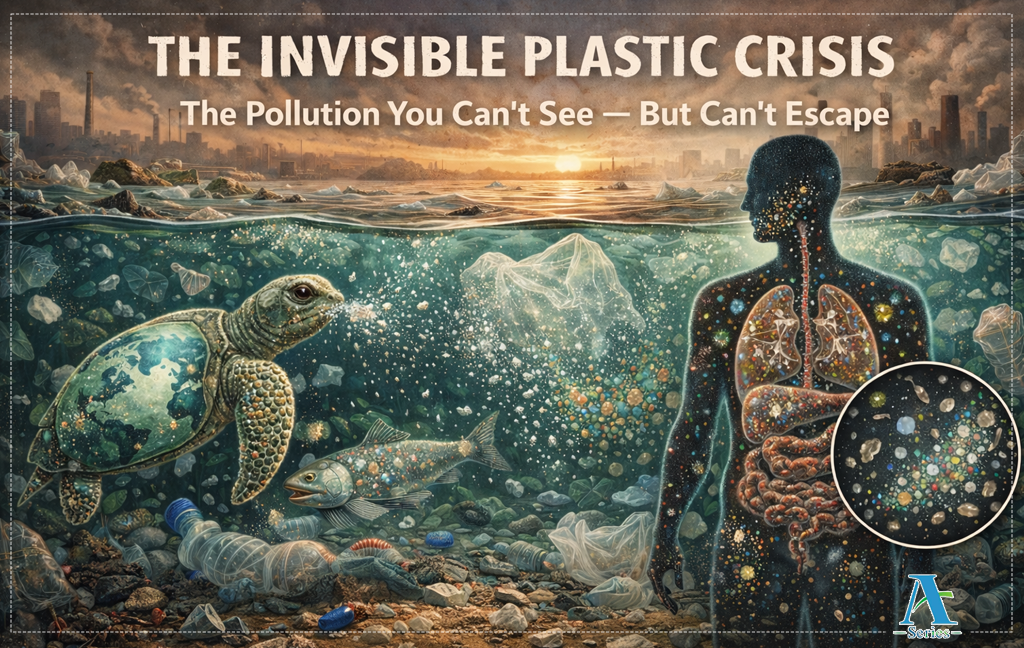
We once thought plastic pollution meant bottles floating in the ocean or bags tangled in trees. That image, while still real, is now dangerously incomplete. Today, the crisis has evolved far beyond what our eyes can detect. Microplastics and nanoplastics particles so tiny they are invisible to the naked eye have silently infiltrated every corner of our planet and, more alarmingly, every corner of our bodies. This is no longer just an environmental issue. It is a public health emergency hiding in plain sight.
What Are We Actually Talking About?
Microplastics are plastic particles smaller than 5 mm. Nanoplastics are even tinier, ranging from just 1 to 1,000 nanometres in size smaller than most living cells. Both originate from the breakdown of larger plastic items through sunlight exposure, heat, and environmental wear. Common sources include synthetic clothing fibres, car tyre dust, plastic packaging, cosmetics, industrial pellets, and even disposable face masks worn during the COVID-19 pandemic.
According to a 2025 comprehensive review published in The Lancet Planetary Health, these particles are now formally classified as “emerging pollutants widely dispersed in the environment,” with humans primarily exposed through ingestion, inhalation, and skin contact. The scale is staggering experts from the World Economic Forum (2025) estimate that people inhale approximately 68,000 microplastic particles every single day. We are, quite literally, breathing plastic.
Everywhere Literally
Recent research has shattered the comforting myth that remote or pristine environments are spared. Scientists discovered in early 2026 that the ocean’s “missing” plastic has not disappeared it has broken down into trillions of invisible nanoplastics now circulating through water, air, and living organisms. In a separate alarming finding, researchers confirmed that microplastics are quite literally falling from the sky drifting through the atmosphere and settling into forests, mountains, and farmland far from any human settlement.
Perhaps most unsettling of all, microplastics and nanoplastics have now been confirmed in human blood, lungs, liver, placentas, and even brain tissue. What began as an ecological inconvenience has become a molecular-level invasion of the human body.
The Health Threat Growing in the Dark
The biological implications are deeply distressing. A 2025 study in Science Advances found that microplastics in the bloodstream can cause cerebral thrombosis, potentially triggering neurobehavioral abnormalities. Beyond the brain, exposure is linked to metabolic disorders, respiratory diseases, and chronic inflammation.
The financial burden is equally heavy. The Global Wellness Institute (2026) warns that global health costs tied to plastic exposure including endocrine disorders and cardiovascular risks are projected to exceed $250 billion annually by 2030.
India & the Invisible Plastic Crisis: Facts, Figures & Fight Back
India stands at a critical crossroads in this global crisis acting as both a major contributor to the problem and an increasingly sophisticated responder.
The Scale of the Problem
India generates approx 9.3 million tonnes of plastic waste every year, accounting for nearly 20% of the global total. However, the true depth of the crisis may be underreported. A 2025 study published in Nature revealed that India's actual per capita plastic waste generation is 0.54 kg/day more than four times the previous official estimate of 0.12 kg/day. This discrepancy points to a massive data gap, particularly in rural areas where waste management infrastructure is often non-existent.
Key Policy Steps Taken
The Indian government has responded with one of Asia's most detailed regulatory frameworks:
- In July 2025, a mandatory QR code and barcode system was introduced, ensuring every piece of plastic packaging is digitally linked to its origin and disposal record.
- The Plastic Waste Management (Amendment) Rules, 2026, mandated that rigid packaging must contain 30% recycled plastic this year, scaling to 60% by 2028–29.
- Extended Producer Responsibility (EPR) remains the backbone of the strategy, forcing brands to take financial responsibility for their waste under the "Polluter Pays" principle.
On-Ground Innovation & Enforcement
- The CPCB introduced AI-based monitoring in 2025 to detect industrial violations in real-time.
- Swachh Bharat Mission 2.0 is currently funding specialized sorting centers across urban hubs.
- Violations of single-use plastic bans now carry individual fines of Rs.500 and institutional fines of Rs.5,000.
The Gap That Remains
Despite these strides, enforcement remains uneven. Source segregation at the household level is still inconsistent, and many Gram Panchayats lack the technical funding to implement these high-level mandates. Furthermore, the informal waste sector the backbone of Indian recycling remains largely outside the formal safety net.
India’s plastic crisis may be visible in its landfills, but the silent threat of microplastics is the real ticking time bomb. As the nation tightens its rules, the ultimate test will be whether policy ambition can truly cleanse the air we breathe and the water we drink.
The planet doesn’t need our apology. It needs our action now
Source:
- The Lancet Planetary Health — Microplastic and Nanoplastic Pollution & Disease Risks (December 2025)
- World Economic Forum: How Microplastics Get Into the Food Chain (February 2025)
- ScienceDaily: Scientists Solved the Mystery of Missing Ocean Plastic (March 2026)
- Science Advances: Microplastics in the Bloodstream and Cerebral Thrombosis (2025)
- Global Wellness Institute: Microplastics Watch Initiative Trends for 2026 (April 2026)
- Nature (2025): India’s Per Capita Plastic Waste Generation
- MoEFCC / ChemAnalyst: Plastic Waste Management (Amendment) Rules, 2026 (March 2026)
- PMC / NCBI: Micro- and Nanoplastics: Emerging Environmental & Health Threats (2025)
Blog by Vartika
From Sustainability Division