Turning Leaf Waste into Energy: A Scalable Path to Urban Sustainability
Rapid urbanization in India has intensified the challenge of municipal solid waste (MSW) management. While rural areas can often rely on natural degradation due to land availability, cities face acute land constraints. A significant yet underutilized fraction of MSW is garden waste i.e. dry leaves, twigs, and pruning residues. Characterized by low bulk density (75–100 kg/m³), this waste occupies disproportionate landfill volume. Conventional solutions are limited: composting is hindered by the high ash content of leaves, and open burning still widely practiced which contributes to severe air pollution. Incineration, though effective in volume reduction, is often economically and operationally unviable in developing contexts due to high moisture content and capital intensity.
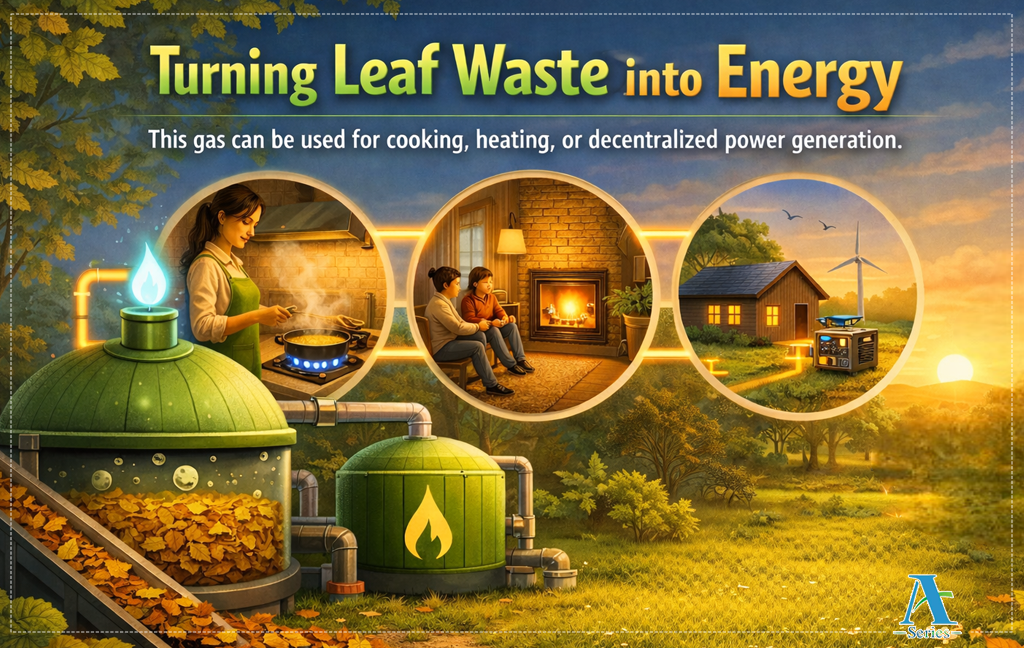
A technically robust and sustainable alternative is biomass gasification, a controlled thermochemical process that converts solid biomass into producer gas (syngas) a mixture of CO, H?, and CH? with a calorific value of 4–6 MJ/kg. This gas can be used for cooking, heating, or decentralized power generation. Compared to incineration, gasification offers better process control, lower emissions, and modular scalability, making it suitable for distributed urban applications.
However, raw garden waste presents operational challenges for gasifiers due to its heterogeneity and poor flow characteristics. To address this, pelletisation is employed as a critical pre-processing step. By converting loose biomass into dense, uniform pellets, pelletisation improves feed consistency, enhances reactor stability, and increases overall conversion efficiency.
The Tata Centre for Technology and Design (TCTD) at IIT Bombay has developed an integrated solution that combines waste pre-processing, pelletisation, and gasification to manage 2–3 tonnes/day of garden waste at the campus scale. The process chain includes segregation, shredding, drying, removal of inert materials (sand and gravel), and pellet production (~50 kg/hr). These pellets are then fed into a modified fixed-bed downdraft gasifier (adapted from TERI design).
Under optimized conditions specifically an equivalence ratio of ~0.33 and pellet ash content of ~10% the system generates producer gas with a calorific value of ~3.67 MJ/kg and achieves a cold gas efficiency of approximately 55%. Detailed parametric studies on airflow rate, solid feed rate, and air distribution have been conducted to optimize performance.
A key technical barrier encountered was clinker formation, caused by ash melting and agglomeration, which obstructs the grate and disrupts operation. This was effectively mitigated through uniform air distribution across the reactor cross-section and frequent mechanical grate movement, reducing clinker formation by over 90%. Building on these improvements, IIT Bombay has developed a patented gasifier design specifically optimized for high-ash biomass feedstocks like leaf litter.
From a sustainability perspective, the system delivers multi-dimensional benefits. It diverts waste from landfills, reduces open burning and associated particulate emissions, and generates clean, locally usable energy, thereby lowering dependence on LPG in applications such as community cooking. The system is economically attractive, with an estimated payback period of around one year, and operationally flexible, capable of utilizing alternative feedstocks like agro-residues, wood, or coal blends.
Deployment potential is high across institutional campuses, industrial townships, residential colonies, and religious centers with large-scale cooking needs. Beyond waste management, the technology supports circular economy principles, enhances resource efficiency, and contributes to carbon footprint reduction.
In essence, IIT Bombay’s “leaf-to-gas” approach reframes urban biomass waste as a valuable energy resource, offering a practical, scalable, and sustainable pathway for cleaner cities and decentralized energy resilience.
As India moves towards stricter environmental compliance and ambitious sustainability targets, the need for practical, scalable, and compliant waste management solutions has never been greater. Technologies like leaf-to-gas gasification demonstrate how low-value municipal waste can be transformed into a reliable source of clean energy aligning directly with circular economy and ESG objectives.
Aseries Envirotek India Private Limited, as a leading compliance execution and sustainability solutions company, is actively working at the intersection of policy, technology, and on-ground implementation. We recognize that innovation alone is not enough successful deployment requires regulatory alignment, operational expertise, and measurable impact delivery.
We invite:
- Urban Local Bodies (ULBs) to adopt decentralized waste-to-energy systems to reduce landfill dependency and eliminate open burning
- Industries and institutional campuses to integrate such solutions within their CSR and ESG frameworks, reducing Scope 1 emissions and fossil fuel dependence
- Bulk waste generators to move beyond compliance and adopt resource recovery models that convert waste into value
Aseries Envirotek India Private limited provides end-to-end support from regulatory compliance feasibility assessment, technology integration, to execution and monitoring ensuring that sustainability initiatives are not just conceptual, but fully operational and compliant.
The transition to a cleaner, circular future requires collaboration and decisive action. We encourage stakeholders to partner with us in deploying innovative solutions like leaf-to-gas systems, turning environmental responsibility into measurable outcomes.
Let’s move from waste management to resource management together.
Source:
https://rnd.iitb.ac.in/node/1063