Environmental Baseline Studies: Why Poor Data Leads to Regulatory Delays
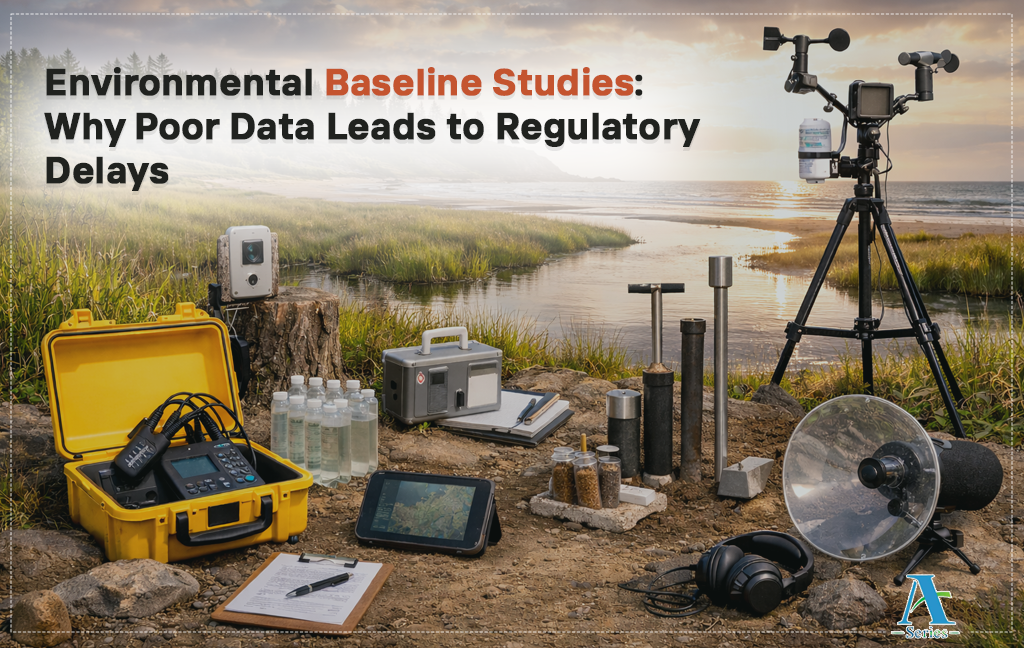
Environmental baseline studies form the scientific and regulatory foundation of environmental approvals in India. Whether under the Environmental Impact Assessment (EIA) Notification, Consent to Establish, Consent to Operate, or project expansion approvals, baseline data is the primary reference against which all projected environmental impacts are evaluated. Regulatory authorities depend on this data to understand existing environmental conditions, assess site sensitivity, determine permissible limits, and prescribe mitigation measures. Consequently, the quality, representativeness, and credibility of baseline data directly influence the speed and outcome of regulatory decision-making.
From a research and regulatory perspective, baseline studies are intended to establish a reliable reference state of the environment prior to project implementation. Internationally accepted assessment frameworks and environmental risk literature consistently emphasise that impact prediction is only as robust as the baseline on which it is built. In the Indian context, baseline studies typically cover ambient air quality, surface and groundwater quality, soil characteristics, noise environment, meteorological parameters, ecological receptors, and, where relevant, socio-economic conditions. These parameters collectively inform regulators about environmental carrying capacity, assimilative potential, and the vulnerability of surrounding receptors.
In recent years, regulatory scrutiny of baseline studies has intensified. This shift is supported by empirical evidence from regulatory practice, judicial observations, and environmental research that links poor baseline data to post-clearance violations, ineffective mitigation, and environmental damage. Decisions by the National Green Tribunal have repeatedly highlighted deficiencies in baseline data collection, data authenticity, and analytical rigor as critical weaknesses in environmental submissions. As a result, regulators now evaluate baseline studies not only for compliance with guidelines but also for scientific defensibility and reproducibility.
One of the primary reasons poor baseline data leads to regulatory delays is inadequate temporal coverage. Environmental parameters, particularly air and water quality, exhibit strong seasonal variability. Research in environmental monitoring demonstrates that short-duration or partial-season data often underestimates peak pollutant concentrations and fails to capture worst-case conditions. When baseline monitoring does not align with prescribed seasonal requirements, regulators are compelled to seek fresh data, leading to deferred appraisals and extended approval timelines.
Equally significant is the issue of spatial non-representativeness. Environmental exposure pathways are inherently location-specific, influenced by wind patterns, hydrology, land use, and population distribution. Studies in atmospheric dispersion and watershed management have shown that poorly selected monitoring locations can distort environmental risk assessments. Regulators therefore question baseline datasets that exclude downwind areas, nearby habitations, water bodies, or ecologically sensitive zones, often requiring additional monitoring or justification.
Data integrity and credibility are another major area of regulatory concern. Environmental compliance research consistently identifies questionable data quality as a leading cause of regulatory intervention. Uniform trends across parameters, unexplained anomalies, lack of quality assurance documentation, or absence of accredited laboratory credentials undermine confidence in baseline datasets. To address this, regulators increasingly examine sampling protocols, laboratory accreditation, calibration records, and quality control procedures to ensure that baseline data is verifiable and reproducible.
Poor integration of baseline data into impact prediction further weakens regulatory submissions. Environmental assessment literature stresses that baseline data must inform quantitative impact modelling, emission assessments, and mitigation planning. When baseline conditions are presented descriptively without analytical linkage to projected impacts, regulators perceive the assessment as generic and non-site-specific. This often results in requests for revised impact analysis or additional supporting studies.
Another research-backed limitation is the failure to consider cumulative and regional environmental context. Studies on industrial clusters and urban environmental systems show that incremental impacts accumulate over time and space, often exceeding thresholds even when individual projects appear compliant. Regulators are therefore increasingly attentive to regional pollution loads and cumulative stress, and baseline studies that ignore this context are viewed as incomplete.
The regulatory implications of weak baseline studies are well documented. Projects with inadequate baseline data frequently face multiple rounds of clarification, deferred appraisal committee consideration, stringent consent conditions, mandatory re-monitoring, and heightened legal vulnerability. From a project management and investment perspective, these delays translate into cost escalation, schedule uncertainty, and reputational risk.
Conversely, research-grade baseline studies characterised by adequate temporal and spatial coverage, transparent quality control, analytical integration, and alignment with regional data function as effective decision-support tools. Such studies reduce information asymmetry between project proponents and regulators, improve regulatory confidence, and facilitate smoother approval processes. As environmental governance in India becomes increasingly data-driven, baseline studies are evolving from procedural documentation into strategic instruments for risk mitigation and regulatory certainty.
In conclusion, environmental baseline studies are not merely a statutory requirement but a scientific commitment that shapes regulatory outcomes. Poor-quality data inevitably leads to regulatory delays, while robust, defensible baseline studies enable timely approvals and sustainable project development. In an era of heightened environmental scrutiny, investing in strong baseline data is not an added cost but it is a prerequisite for regulatory efficiency and long-term compliance.