India’s EV Moment: Why the Next Five Years Matter More Than the Last Ten
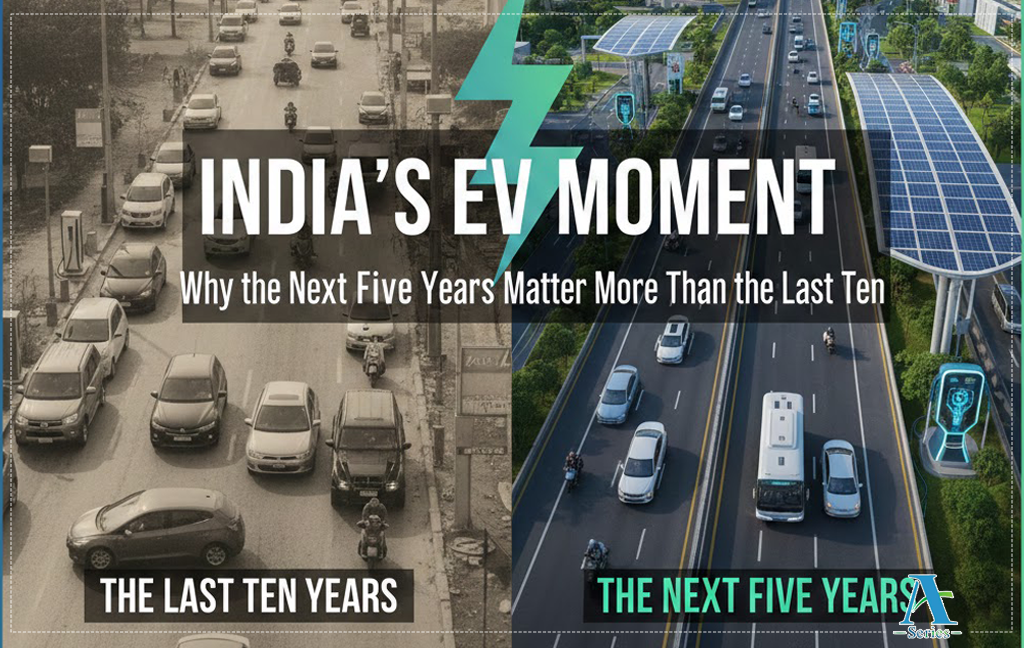
The "early adopter" phase is over. According to the latest NITI Aayog report, India’s $200 billion electric future now depends on shifting gears from subsidies to structural mandates and saturating key cities.
If one looks at the rearview mirror of India's automotive sector, the view is spectacular. In 2016, the country sold a meager 50,000 electric vehicles (EVs). By the end of 2024, that number had rocketed to 2.08 million units annually—a staggering 41x growth.
But as we stand in late 2025, looking at the road ahead, the incline gets much steeper.
A landmark new report by NITI Aayog, titled "Unlocking a $200 Billion Opportunity: The 2025-2030 EV Roadmap," delivers a sobering reality check: The last decade was about proving that Indians want EVs. The next five years are about proving we can build the industrial ecosystem to support them at scale.
We are currently at a 7.6% overall EV penetration. To hit the national target of 30% by 2030, business as usual won't cut it. Here is why NITI Aayog argues this is India's definitive EV moment.
- The Status Quo: A Tale of Two Speeds
The first phase of India's EV revolution was lopsided. It was driven by individual consumers (two-wheelers) and small business owners (three-wheelers), largely fueled by the FAME subsidies.
As the report highlights, electric two-wheelers (E2W) and three-wheelers (E3W) currently account for nearly 95% of total EV sales. The heavy lifters—passenger cars, buses, and trucks—are still largely running on fossil fuels.
The challenge now is migrating this success to heavier segments where emissions are highest, but the capital costs are prohibitive.
- The Stakes: The $200 Billion Prize
Why the urgency? NITI Aayog emphasizes that hitting the 2030 targets isn't just about clean air; it's a massive economic unlock.
The report projects that achieving the 30% penetration target by 2030 will create an entire new value chain worth $200 billion. Furthermore, it stands to generate over 10 million direct and indirect jobs and could save the exchequer billions by reducing oil imports by an estimated 474 million tonnes of oil equivalent (Mtoe) between now and 2035.
The prize is massive, but the window to secure it is shrinking.
- The Strategic Shift: From "Carrots" to "Mandates"
Perhaps the most critical insight in the 2025 report is the signal that the era of relying solely on subsidies (the "carrots") is maturing. The FAME schemes did their job to kickstart the market. Now, the focus must shift to structural changes and regulatory "sticks."
NITI Aayog recommends a three-pronged strategic pivot:
- ZEV Mandates: Moving beyond voluntary adoption, the report suggests implementing Zero Emission Vehicle mandates, requiring manufacturers to produce a minimum percentage of EVs.
- The "Saturation" Model: Instead of spreading infrastructure thin across thousands of towns, the new strategy calls for selecting five pilot cities for 100% electrification of public transport and last-mile delivery within five years. This creates dense, functional blueprints that can be replicated.
- Stricter CAFE Norms: Tightening Corporate Average Fuel Efficiency standards to make internal combustion engine vehicles increasingly expensive to manufacture.
- The Major Hurdle: The Financing Trap
Why aren't more fleet operators buying electric trucks and buses? The technology is ready, but the financing is broken.
NITI Aayog identifies financing as the single biggest bottleneck for commercial EV adoption. Because banks still view EVs (and their batteries) as high-risk assets with uncertain resale value, interest rates are crippling.
- The Reality: An electric truck operator often faces interest rates as high as 18%, whereas their diesel counterpart gets financed at 10-12%.
- The Solution: The report urgently calls for including EVs under Priority Sector Lending (PSL) and creating a government-backed "Blended Finance" facility to de-risk these loans and bring interest rates down to single digits.
- The Tech Unlock: Batteries and Data
To sustain this growth, India needs massive energy storage—an estimated 250+ GWh of annual battery demand by 2035.
The report emphasizes that we cannot rely solely on imported cells. The success of the Production Linked Incentive (PLI) scheme for Advanced Chemistry Cells is crucial to bringing battery costs definitively under the $100/kWh threshold.
Furthermore, NITI Aayog advocates for the immediate implementation of "Battery Passports"—unique digital IDs that track a battery's health and usage. This data is the missing link required to establish a robust second-life market for batteries, which would significantly lower the upfront cost of new EVs.
Conclusion
The last ten years were the prologue. We proved the skeptics wrong and showed that electric mobility works in the unique Indian context.
But as NITI Aayog makes clear, the next five years are the main event. We must move from early adoption to mass adoption, from 2-wheelers to 18-wheelers, and from government subsidies to viable market financing. The roadmap to a $200 billion electric economy is laid out; now we must summon the industrial and political will to travel it at speed.
Source:
NITI Aayog. (2025). Unlocking a $200 billion opportunity: Electric vehicles in India. Government of India. https://www.niti.gov.in/sites/default/files/2025-08/EV-Report.pdf