Bio-Bitumen via Pyrolysis: From Farm Residue to Roads
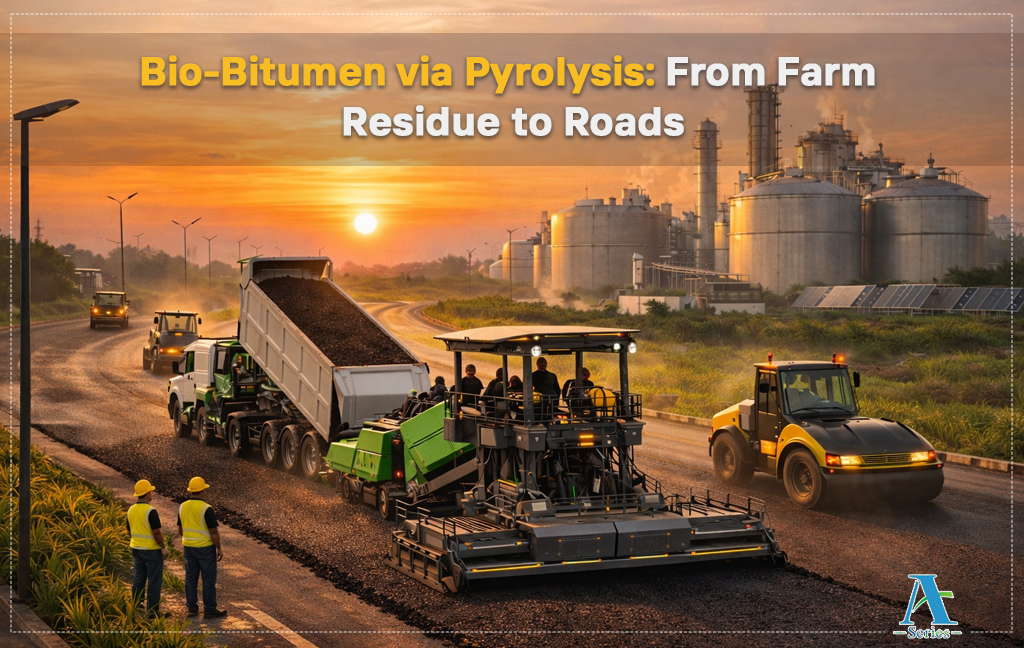
India’s rapid expansion of road and highway infrastructure has led to a sharp rise in demand for bitumen, a critical binder used in flexible pavements. At present, nearly 50% of India’s bitumen requirement is met through imports, exposing the sector to volatility in crude oil prices and supply-chain risks. In this backdrop, bio-bitumen is emerging as a technically viable, environmentally sustainable, and strategically important alternative that supports both climate goals and national self-reliance.
What is Bio-Bitumen?
Bio-bitumen is a bio-based or waste-derived binder produced from renewable feedstocks such as biomass, agricultural residues, lignin, and organic waste streams. Through advanced processing, these materials are converted into a binder with functional characteristics comparable to conventional petroleum bitumen. In practice, bio-bitumen is typically used as a partial replacement or modifier, allowing it to integrate seamlessly into existing asphalt production and laying systems.
Indigenous Innovation by CSIR-CRRI and CSIR-IIP
A major breakthrough in India’s sustainable road materials landscape has been achieved by CSIR–Central Road Research Institute (CSIR-CRRI) in collaboration with CSIR–Indian Institute of Petroleum (CSIR-IIP). The institutions have developed bio-bitumen using pyrolysis technology, a thermochemical process in which biomass is decomposed in the absence of oxygen to produce bio-oil. This bio-oil is subsequently upgraded and blended with conventional bitumen to create a road-grade binder.
The process involves the collection of post-harvest rice straw, its pelletisation, followed by pyrolysis to generate bio-oil, which is then blended with petroleum bitumen. This approach directly addresses two national priorities i.e. agricultural residue management and reduction in bitumen imports while aligning with India’s circular economy and waste-to-wealth initiatives.
Technical Validation and Performance Assessment
The developed bio-bitumen has undergone extensive laboratory validation, demonstrating that 20–30% of conventional bitumen can be safely replaced without compromising pavement performance. Comprehensive physical, rheological, chemical, and mechanical characterisation has been carried out, including critical performance tests for rutting resistance, cracking behaviour, moisture damage susceptibility, and resilient modulus. The results confirm that the bio-bitumen blends meet established performance benchmarks required for road construction.
Field Demonstration and Commercial Readiness
To validate real-world applicability, a 100-metre trial stretch using bio-bitumen has been successfully laid on the Jorabat–Shillong Expressway (NH-40) in Meghalaya. The trial confirmed satisfactory constructability and in-service performance under actual traffic and climatic conditions, establishing field-level feasibility. The technology has progressed beyond the research stage, with a patent filed and multiple industry partners onboarded for commercial deployment, indicating strong readiness for scale-up.
Global Context and Alignment
Internationally, countries across the European Union, the United States, China, Japan, and Australia are already deploying bio-bitumen or similar bio-based asphalt binders, primarily as partial replacements or performance modifiers. The prevailing global approach is hybrid application blending bio-based binders with petroleum bitumen to reduce carbon intensity while maintaining durability. India’s CSIR-led development is therefore fully aligned with global best practices, while leveraging domestic biomass resources.
Why Bio-Bitumen Matters for India
The adoption of bio-bitumen offers multiple strategic advantages:
- Reduced dependence on imported bitumen
- Lower lifecycle greenhouse gas emissions
- Productive utilization of agricultural and organic waste
- Strong alignment with ESG frameworks, green highways, and sustainable infrastructure policies
Conclusion
Bio-bitumen represents more than a material innovation it is a strategic enabler for resilient, low-carbon, and self-reliant infrastructure development. With proven laboratory performance, successful field trials, and growing industry participation, bio-bitumen is well positioned to transition from pilot applications to mainstream adoption in India’s road sector, supporting both environmental sustainability and economic resilience.
Source: Indian Chemical News – CSIR-CRRI and CSIR-IIP Develop Bio-Bitumen via Pyrolysis
https://www.pib.gov.in/PressReleasePage.aspx?PRID=2212118®=6&lang=1