Biovectoring of Plastic Waste: India’s Overlooked Leakage Pathway
India’s plastic waste challenge is typically framed around collection gaps, recycling inefficiencies, and the role of Extended Producer Responsibility (EPR). However, an often-overlooked dimension is biovectoring is the process by which animals inadvertently transport and redistribute plastic waste across ecosystems. While not a primary source of pollution, biovectoring acts as a force multiplier, complicating containment and recovery efforts.
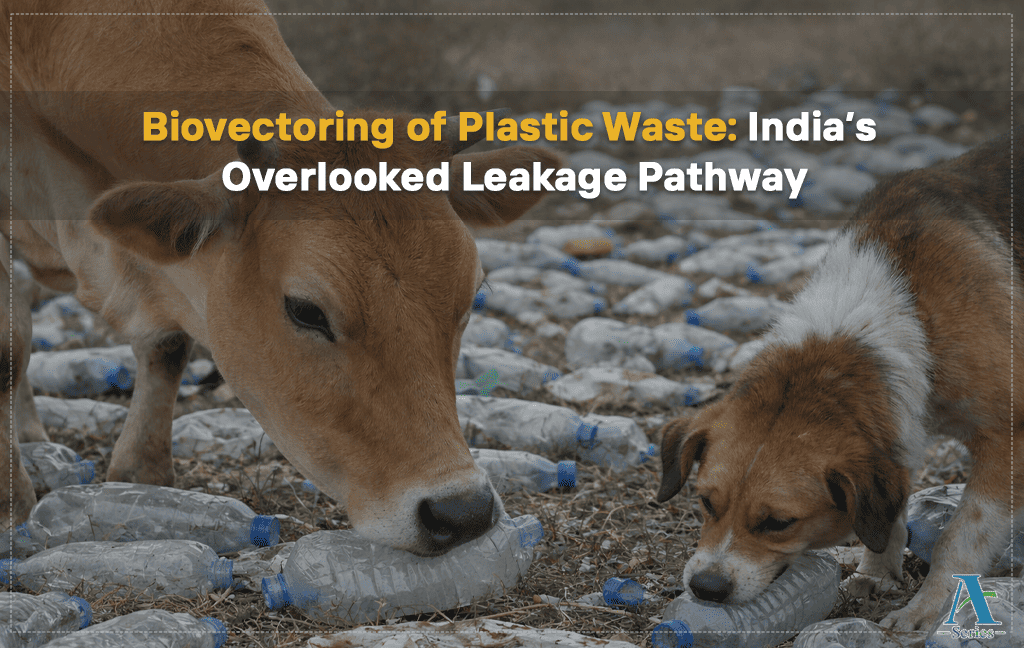
Biovectoring occurs when animals such as stray cattle, birds, and aquatic species ingest or carry plastic materials, later depositing them in different locations through excretion, regurgitation, or simple displacement. In India, where open dumping and poorly secured waste storage are still prevalent, the interface between waste and animals is frequent and unavoidable. Urban peripheries, highways, and landfill sites become hotspots where animals consume plastic mixed with food waste.
The implications are both ecological and economic. From an environmental standpoint, plastics that are transported into agricultural fields, forest fringes, and water bodies become significantly harder to track and recover. This contributes to diffuse pollution, where waste is no longer concentrated but dispersed across landscapes. Moreover, once ingested, plastics are subjected to mechanical and chemical processes within digestive systems, accelerating their breakdown into microplastics a far more persistent and hazardous form of pollution.
At the same time, the impact on animals themselves is severe and often fatal. In India, stray and free-grazing cattle are particularly vulnerable, frequently ingesting plastic along with food waste. This leads to gastrointestinal blockage, where plastics accumulate in the rumen, preventing proper digestion and causing chronic starvation. Sharp fragments can result in internal injuries and infections, while chemical additives in plastics introduce toxic exposure affecting vital organs. Over time, animals experience false satiety, malnutrition, reduced milk yield, and weakened immunity, directly impacting rural livelihoods. In extreme cases, post-mortem examinations have revealed several kilograms of plastic in cattle stomachs, underscoring the scale of the problem.
Despite these impacts, biovectoring remains largely absent from India’s regulatory and policy discourse. Current frameworks, including the Plastic Waste Management Rules and EPR guidelines, focus on collection, recycling, and end-of-life disposal, but do not explicitly account for secondary redistribution pathways. As a result, official estimates of plastic leakage into the environment may be understated, as they assume waste remains within predictable management streams.
That said, it is important to maintain perspective. Biovectoring is not a dominant waste flow when compared to systemic inefficiencies such as low segregation rates or inadequate infrastructure. Its significance lies in how it undermines otherwise functional systems by redistributing waste beyond points of control. Even a well-designed collection network loses effectiveness if waste is continuously displaced into informal or inaccessible environments.
Addressing biovectoring does not require entirely new technologies, but rather strengthening upstream waste management practices. Ensuring strict source segregation, deploying closed and animal-resistant waste storage systems, and improving the frequency and reliability of municipal collection can significantly reduce animal access to plastics. Additionally, stricter enforcement on low-value, high-leakage items such as thin plastic carry bags would directly limit the materials most commonly ingested by animals.
In conclusion, biovectoring should be understood as a hidden leakage pathway within India’s plastic waste ecosystem. It highlights the dynamic nature of pollution where waste does not remain static but is actively redistributed by biological systems. Recognizing this phenomenon strengthens the argument for preventive, upstream interventions, which remain the most effective strategy for tackling plastic pollution at scale.
Call to Action
In conclusion, biovectoring should be understood as a hidden leakage pathway within India’s plastic waste ecosystem. It highlights the dynamic nature of pollution where waste does not remain static but is actively redistributed by biological systems. Recognizing this phenomenon strengthens the argument for preventive, upstream interventions, which remain the most effective strategy for tackling plastic pollution at scale.
In this context, Aseries Envirotek India Private Limited works with producers, importers, and brand owners to implement effective Plastic EPR strategies that go beyond basic compliance. Through structured collection networks, verified recycler partnerships, traceable EPR credit management, and compliance monitoring, organizations can significantly reduce uncontrolled plastic leakage that contributes to issues like biovectoring. Strengthening responsible plastic recovery systems today is essential for protecting ecosystems, livestock, and communities from the long-term impacts of plastic pollution.