When Seasons No Longer Behave Like Seasons: A Sustainability Warning for India
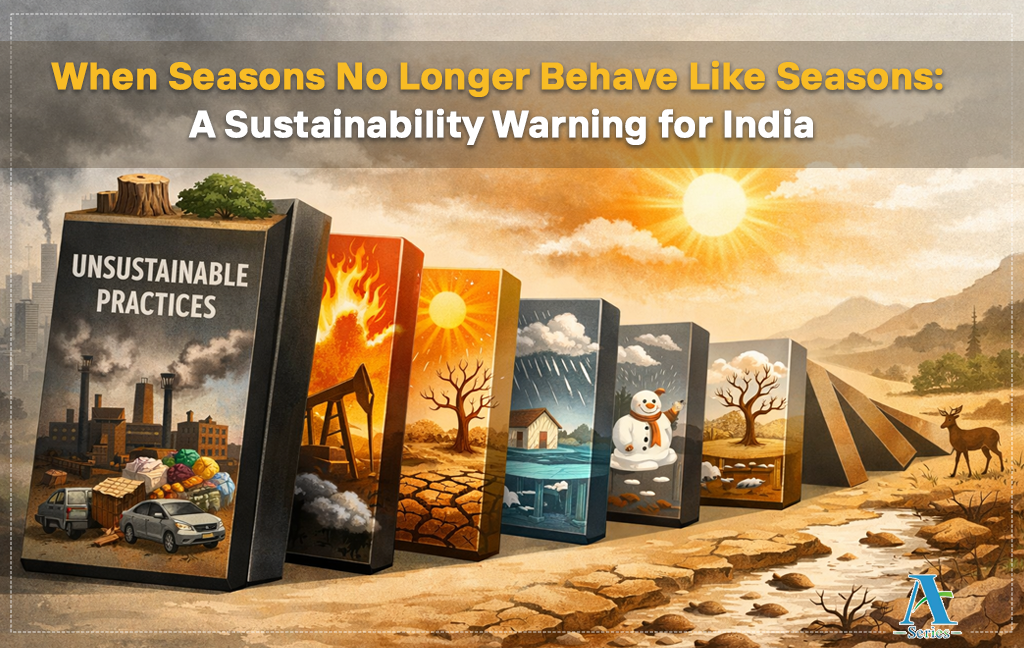
For decades, India’s climate followed a predictable seasonal rhythm that shaped agriculture, water management, and everyday life. Winters were distinctly cool, summers arrived gradually, and the monsoon remained the backbone of ecological and economic planning. February, which traditionally marked the heart of winter, now often feels noticeably warmer, signalling a clear shift in seasonal patterns. This change is not an isolated weather anomaly but an early warning of deeper climate instability.
Disappearing Seasons and Climate Instability
The shrinking distinction between seasons reflects growing instability in India’s climate system. Shorter winters, extended summers, and abrupt temperature spikes point toward broader atmospheric changes driven by rising greenhouse gas emissions, rapid urbanisation, deforestation, and unsustainable land-use practices. As seasonal boundaries blur, ecosystems lose the environmental signals they rely on, resulting in biodiversity stress, soil moisture depletion, and disrupted water cycles.
Why Seasonal Stability Is Central to Sustainability
Sustainability depends on environmental predictability. Agriculture relies on stable temperature transitions and rainfall cycles, while water resources depend on gradual seasonal recharge. When seasons overlap or disappear, farmers face uncertainty in sowing and harvesting, groundwater replenishment becomes irregular, and energy demand rises due to prolonged heat exposure. These disruptions weaken economic resilience and strain natural resources.
Social and Public Health Implications
Weather variability extends beyond environmental impacts to affect human health and social systems. Early and prolonged heat exposure increases cases of heat stress and heat-related illnesses, while shifting weather conditions expand the spread of vector- and water-borne diseases. Vulnerable populations including children, the elderly, and outdoor workers bear the greatest burden, reinforcing that sustainability is inseparable from public health and social equity.
Unsustainable Practices at the Core of the Crisis
The erosion of seasonal patterns is closely linked to long-standing unsustainable development practices. Dependence on fossil fuels, ineffective waste management, expanding urban heat islands, and the loss of forests and wetlands have intensified heat retention and altered local climate dynamics. Disappearing seasons are therefore not merely a consequence of climate change, but evidence of systemic sustainability failures.
Sustainability as the Path Forward
Adapting to extreme weather alone is not enough. Long-term resilience requires embedding sustainability into development planning through emission reductions, circular economy initiatives, ecosystem conservation, and climate-resilient urban and industrial design. Sustainability addresses the root causes of climate instability rather than managing its symptoms.
Conclusion: A Climate Signal We Cannot Ignore
In India, the loss of clearly defined seasons threatens food security, water availability, urban liveability, and regulatory compliance across sectors. When winter months no longer feel like winter, it is more than seasonal discomfort. it is a signal that environmental limits are being crossed. Sustainability is no longer optional; it is essential to preserving climate balance and seasonal stability.