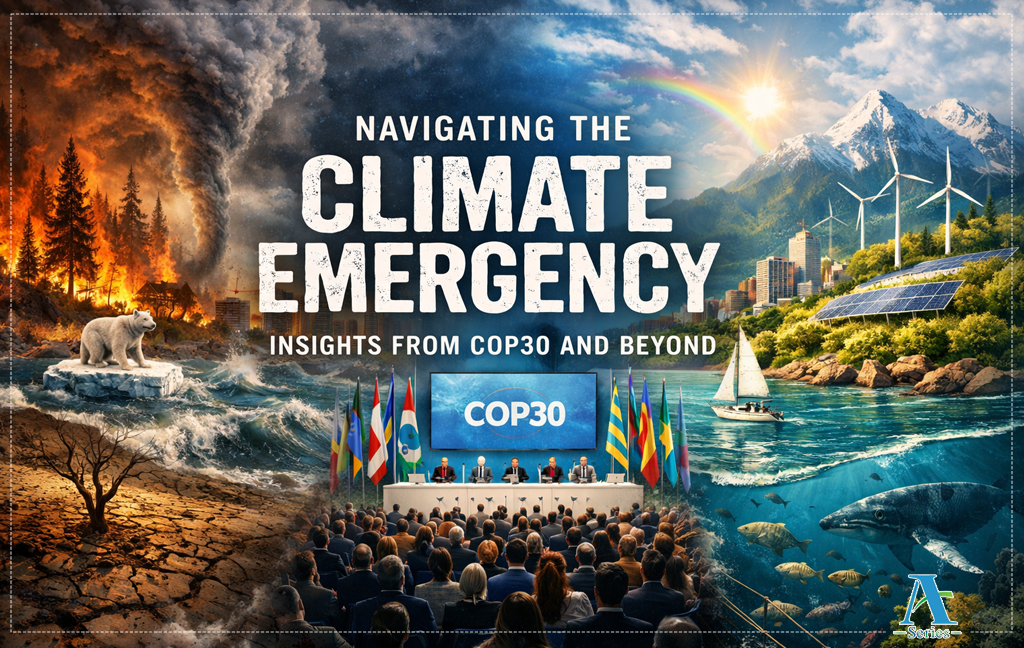
Navigating the Climate Emergency: Insights from COP30 and Beyond
Climate change is no longer a future risk it is a present reality.
As we move through 2026, the global climate crisis has shifted from a distant warning to an immediate economic and humanitarian challenge. Recent data shows that atmospheric CO2 concentrations reached 423.9 ppm in 2024 a 53% increase from pre-industrial levels. With science identifying 450 ppm as a high-risk threshold likely to trigger 2°C of warming and widespread ecosystem disruption, the urgency for collective action has never been greater.
The Global and Local Impact
The physical consequences of this warming are already evident. The 2023–2024 period witnessed the largest ice loss since 1950, while nearly 4 billion people now experience severe water scarcity for at least part of the year.
In India, the impact is particularly acute. In February 2026, temperatures across North and Central India were consistently 3°C to 6°C above normal. More than 57% of Indian districts are currently classified under high to very high heat risk. These environmental stresses carry significant economic implications, with projections indicating a potential 4.5% to 6% reduction in India’s GDP by 2030.
Against this backdrop of escalating impacts, global climate negotiations have taken on renewed urgency.
COP30: From Pledging to Implementation
The COP30 summit in Belém, Brazil, marked a critical inflection point. While previous COPs focused on target-setting, COP30 emphasized implementation, accountability, and climate justice. Key outcomes included a commitment to triple climate adaptation finance by 2035, alongside a formal roadmap to mobilize $1.3 trillion in climate finance.
India played a prominent role at COP30. Union Environment Minister Shri Bhupender Yadav called for greater accountability from developed nations, while also highlighting India’s progress on its “Panchamrit” commitments. Notably, India surpassed its 2030 target of achieving 50% non-fossil fuel-based electric power capacity ahead of schedule in late 2025.
The Corporate Mandate
For the private sector, the implications of these developments are profound. The global shift from voluntary pledges to mandatory implementation is accelerating, accompanied by stricter disclosure requirements and audit mechanisms.
Key trends shaping corporate climate action include:
- Decarbonization commitments: Leading industry players are targeting zero routine flaring and near-zero upstream methane emissions.
- Carbon markets: India is moving toward an emissions-based Carbon Credit Trading Scheme (CCTS), assigning greenhouse gas intensity targets to approximately 490 industrial units.
- Collective action: Initiatives such as the Global Methane Pledge demonstrate that coordinated efforts can reduce the “first-mover disadvantage” and accelerate industry-wide adoption.
Increasingly, climate performance is becoming a determinant of market access, capital allocation, and long-term competitiveness.
Conclusion
As Simon Stiell, UN Climate Change Executive Secretary, aptly stated: “Do or do not. There is no try.”
In this evolving landscape, isolated “islands of excellence” are no longer sufficient. To remain competitive and resilient, businesses must embrace collaboration, industrial symbiosis, and shared infrastructure. Climate action must move beyond compliance to become an integral component of long-term strategy and value creation.
The transition is no longer optional it is already underway.